Commercial & Low-Slope Roofing in Tooele, UT
A low-slope roof almost never fails in the middle. The membrane out in the field is the part everyone looks at, the part that gets specified and argued over in bids, and it is rarely what goes wrong. What goes wrong is the edge. Wind moving across a building generates lift, that lift concentrates hardest at the perimeter and harder still at the corners, and if the edge metal or the perimeter fastening gives up, wind gets under the membrane and peels it back across the field like a lid. In a valley that recorded gusts above 90 miles per hour last August, that is not a theoretical failure mode.
Tooele Roofing Co works commercial and low-slope roofs across Tooele County: the buildings along the SR-36 corridor, the industrial properties out toward I-80, retail and office in Tooele City and Grantsville, and the shops and warehouses on the county's growing edges. We quote the perimeter as carefully as the field, we tell you honestly when a coating is the right answer and when it is a way to postpone a problem, and every assessment comes with photographs and a written condition report you keep.
Get Your Free Commercial Roof Assessment
Commercial Roofing Services We Offer

Commercial Roof Repair
Low-slope leaks are harder to trace than residential ones, because water enters at one point and travels under a much larger deck before it shows up two suites away. We start at the perimeter and the corner zones rather than the nearest ceiling stain, since that is where wind works on a roof first and where a disproportionate share of commercial leaks originate. Seam splits, membrane punctures, failed curb and penetration flashing, and the aging pitch pans nobody has looked at since the building opened. Emergency response for active water, scheduled work around your operating hours for everything else. One threshold worth knowing: water still standing on a low-slope roof 48 hours after a storm is defined as ponding, most membrane warranties exclude it, and in this valley that pond will freeze and thaw its way into a seam before spring. At a glance: TPO, PVC, EPDM, modified bitumen, and coatings · $500–$3,000 per incident · same-day response for active water · perimeter and corner zones inspected first · photo documentation with every repair
At a glance: TPO, PVC, EPDM, modified bitumen, and SPF · $500–$3,000 per incident · same-day response for active water · leak traced to entry point, not to the stain · photo documentation with every repair

Commercial Roof Installation & Replacement
New construction, additions, and re-roofs across the county, coordinated with your general contractor and with the mechanical trades whose curbs, conduit, and gas lines will live on that roof for the next twenty years. Most commercial leaks we get called to fix started as a penetration somebody added after the roofers left. We would rather detail it correctly the first time and put it in the closeout documents. Two things get specified in writing on every proposal: the edge securement system, and how fastening density changes through the perimeter and corner zones. Those are the lines a cheap bid removes and the reason low-slope roofs come apart in wind. If rooftop units are going in, tell us where, because a new unit or screen wall creates a new place for snow to drift. At a glance: new construction, additions, and re-roofs · coordinated with your GC and mechanical trades · edge system and zone fastening specified in writing · manufacturer warranty registered and field-inspected at completion · full closeout package

Commercial Roof Inspections & Condition Reports
Documented assessments for due diligence on a purchase, a lender or insurer requirement, warranty compliance, or a capital planning cycle. You get photographs tied to locations, moisture findings, an honest estimate of remaining service life, and a written recommendation you can hand to an ownership group without translating it first. In a county with confirmed severe weather on the record, there is a second use worth knowing about: a dated report from before storm season is what settles the argument when a carrier later claims your wind or hail damage was pre-existing wear. For owners holding several properties, one visit covers the portfolio with one report per address and one point of contact. At a glance: due diligence, lender and insurer requirements, warranty compliance, and capital planning · pre-storm baseline documentation · moisture survey where replacement is in question · written remaining-service-life estimate · portfolio scheduling available
Systems We Work With

TPO Membrane
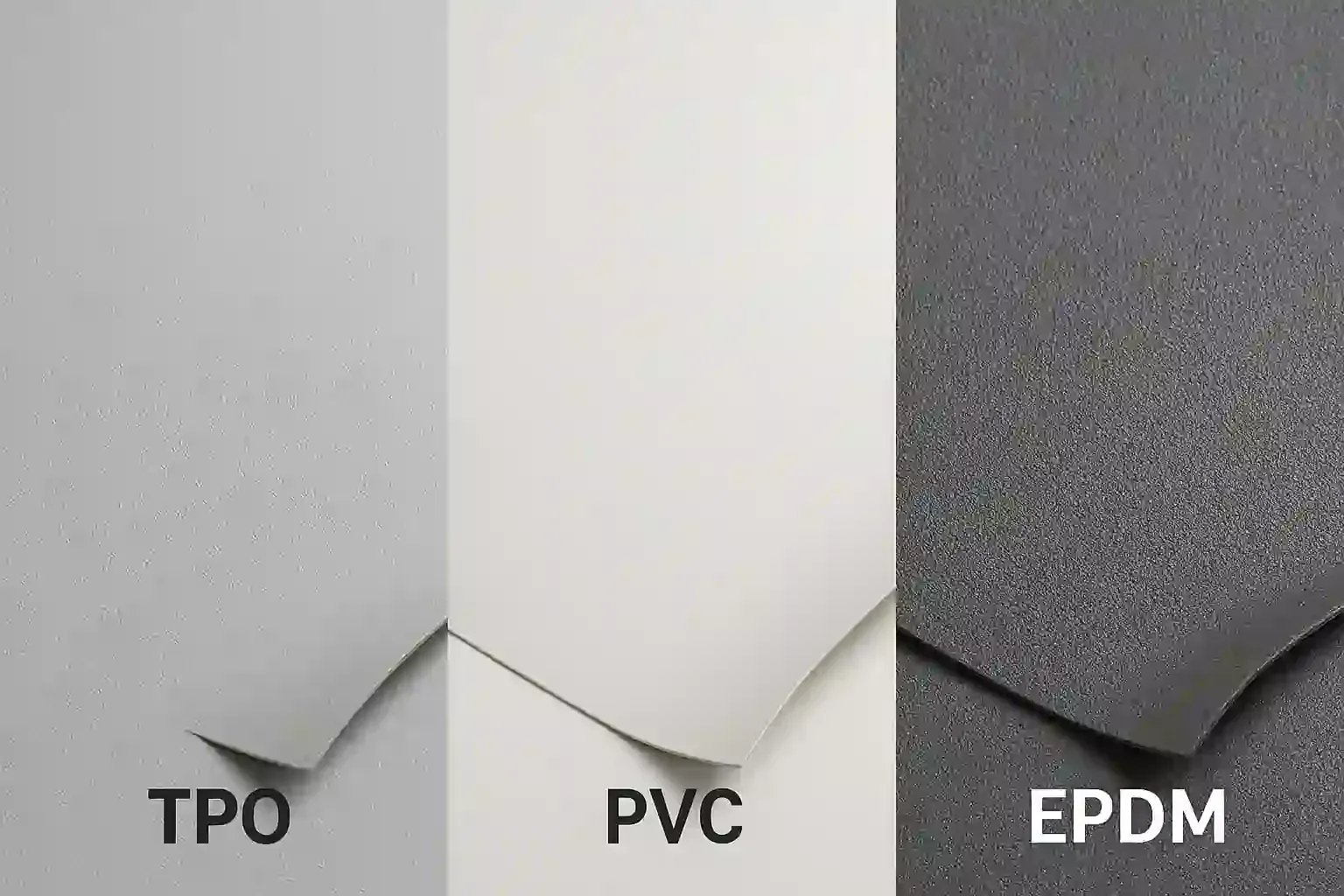
The most common single-ply on new commercial work. Heat-welded seams, good reflectivity, and a strong track record when the perimeter is detailed correctly and the fastening pattern matches the zone. Thickness and attachment method get specified on our estimates rather than left as "TPO."
PVC Membrane
Also heat-welded, and the correct specification when the roof faces chemical exposure. Grease and animal fats from kitchen exhaust will degrade a TPO membrane over time, and PVC resists them, which makes it the standard answer on restaurants and food service buildings. It also holds up well against petroleum contact and has a long cold-climate service record. It typically costs more than TPO, and on a building with rooftop kitchen exhaust that premium is not optional, it is the reason the roof lasts.
EPDM Systems
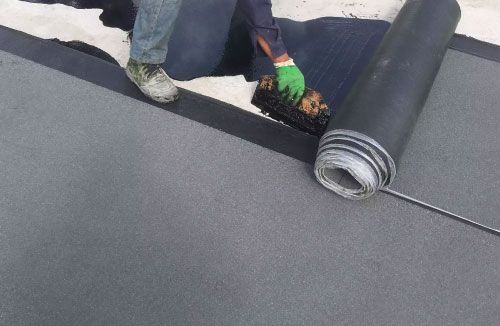
Rubber membrane with a long service history, seamed with tape or adhesive. Handles temperature swing well, which matters in a valley with large daily ranges. Generally black, so reflectivity is not its argument.
Silicone and Acrylic Roof Coatings and Restoration
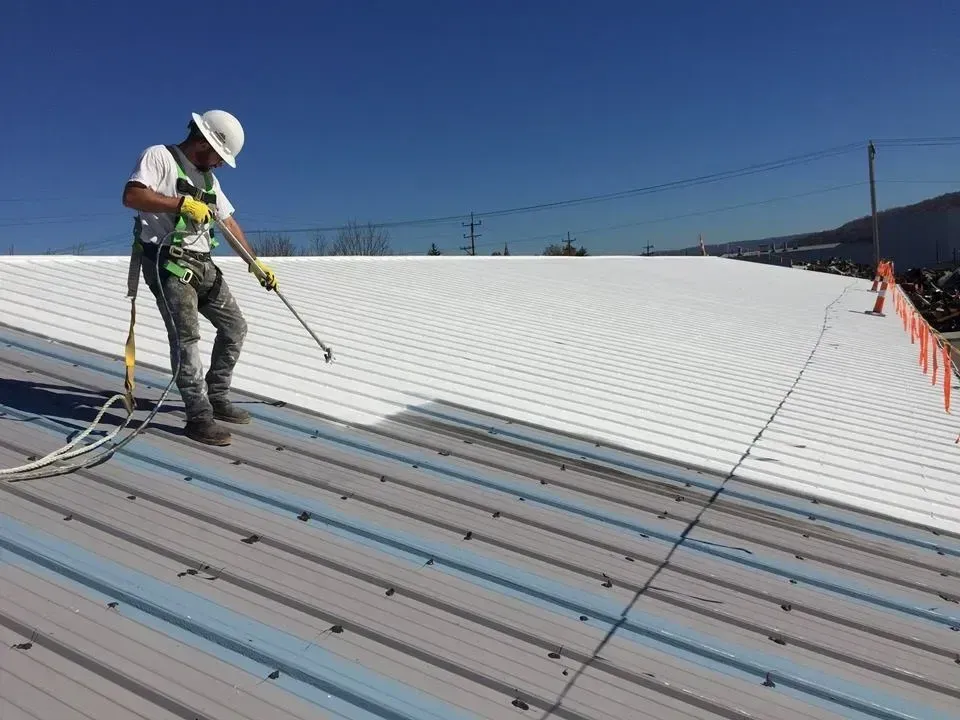
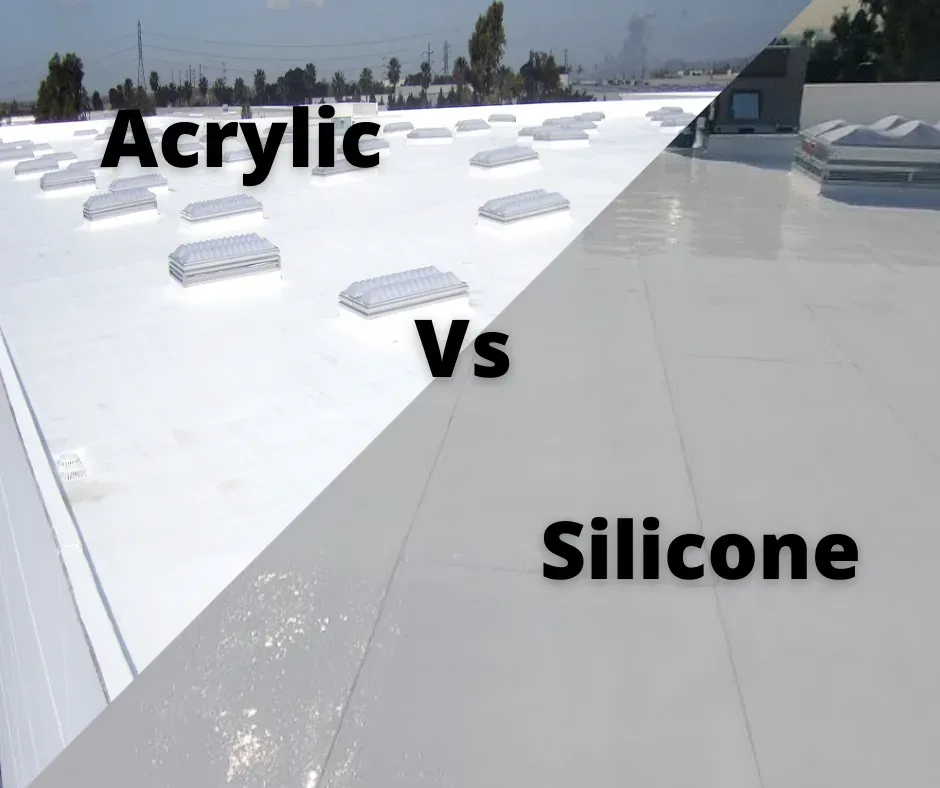
Silicone and acrylic systems applied over a sound existing roof to extend its life. Genuinely useful when the substrate is dry and the roof's problems are surface-level. Genuinely a waste when moisture is already trapped in the insulation, because a coating seals it in. More on that decision below.

Modified Bitumen
Torch, cold-applied, and self-adhered systems, common on older commercial buildings and on small low-slope sections attached to steep-slope roofs.
Metal, Standing Seam and Panel
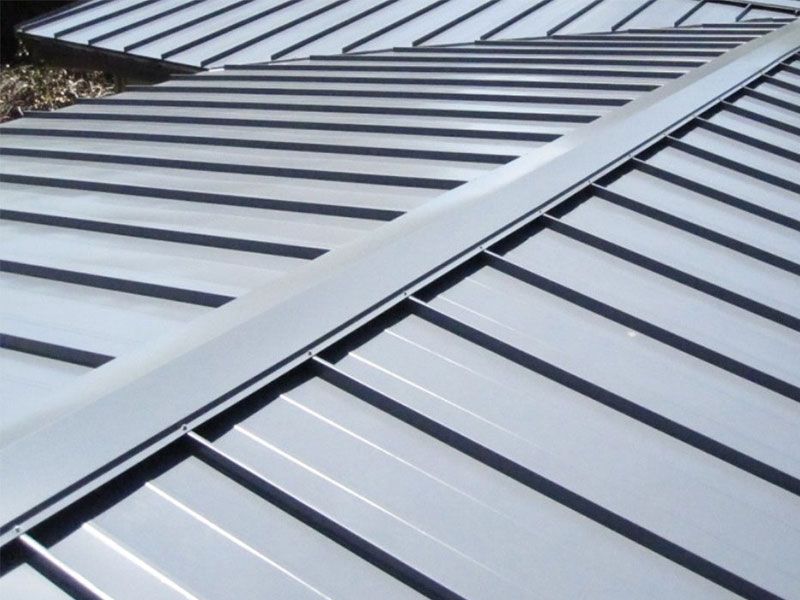
For shops, warehouses, and agricultural-scale commercial buildings. Covered in depth on our metal roofing page.

The Edge Is Where Commercial Roofs Fail
This is the part of a low-slope bid most owners never examine, and it is where the difference between a twenty-year roof and a five-year one usually lives.
Why the perimeter takes the load. Air accelerating over a building creates negative pressure, meaning lift, and that pressure is not uniform. It is highest at the corners, high along the perimeter, and comparatively modest across the middle. A roof assembly engineered as if the whole surface sees the same load is a roof with underbuilt edges.
What Proper Edge Work Involves
- Engineered Edge Metal: Edge metal must be designed and tested for wind securement, not simply bent to fit. Commercial low-slope roofs in Utah are bound by building code to use edge systems compliant with ANSI/SPRI/FM 4435/ES-1. This structural standard exists precisely because perimeter edge failure is the leading catalyst for total roof failure during high-wind events.
- Enhanced Perimeter Fastening: Fastening patterns must be significantly tighter in perimeter and corner zones, utilizing narrower fastener spacing or additional anchor rows compared to the field. A single uniform fastening pattern across the entire roof deck is the most common shortcut hidden in a cheap bid.
- Parapet and Coping Detailing: A parapet wall acts like a sail catching the wind, and its cap functions as a long lever. If the coping lifts due to weak anchors, it unzips the primary membrane termination directly beneath it.
- Specified Membrane Terminations: The membrane must be mechanically terminated at every single vertical intersection using the exact termination bars and sealants specified by the system manufacturer, not whatever generic components happen to be left on the contractor's truck.
What to ask any commercial bidder. How does fastening density change in the corner and perimeter zones, and what edge metal system are you using. Both have specific answers. A bidder who treats those as details rather than as the design is quoting a roof for a calmer place than this one.
Ponding, Freezing, and Why Drainage Matters More Here
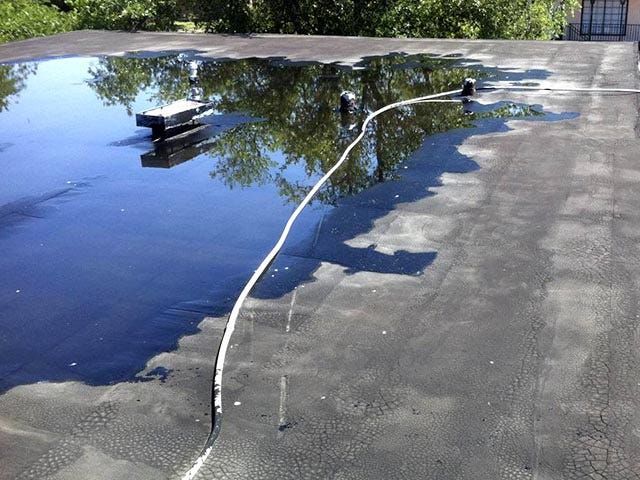
Standing water on a low-slope roof is a problem anywhere. In this valley it is a bigger one, because the water does not simply sit there. It freezes and thaws repeatedly through the winter as daytime temperatures climb and overnight temperatures drop back.
Each cycle expands the ice slightly, and expansion works at exactly the places a membrane is most vulnerable: seams, laps, flashing terminations, and the edges of drains and penetrations. Ponding alone ages a membrane. Ponding that freezes and thaws forty times a winter opens seams that ponding alone would have left intact.
So drainage is not a maintenance detail on a Tooele commercial roof. It is the design question.
- Drains and scuppers cleared before freeze-up, because a blocked drain in November is a pond in January.
- Tapered insulation or crickets to move water off low spots rather than accepting them. Correcting a chronic ponding area during a re-roof costs a fraction of repairing what it eventually causes.
- Overflow provisions that actually work, so a blocked primary drain does not turn into a structural load question.
- Drain sumps and bowls detailed properly, since the membrane transition at a drain is one of the most common leak origins on any low-slope roof.
Snow Drifting on Flat Roofs
Commercial roofs in this valley get a version of the snow load problem that is more severe than what houses face, and for a specific reason: they have more things sticking up.
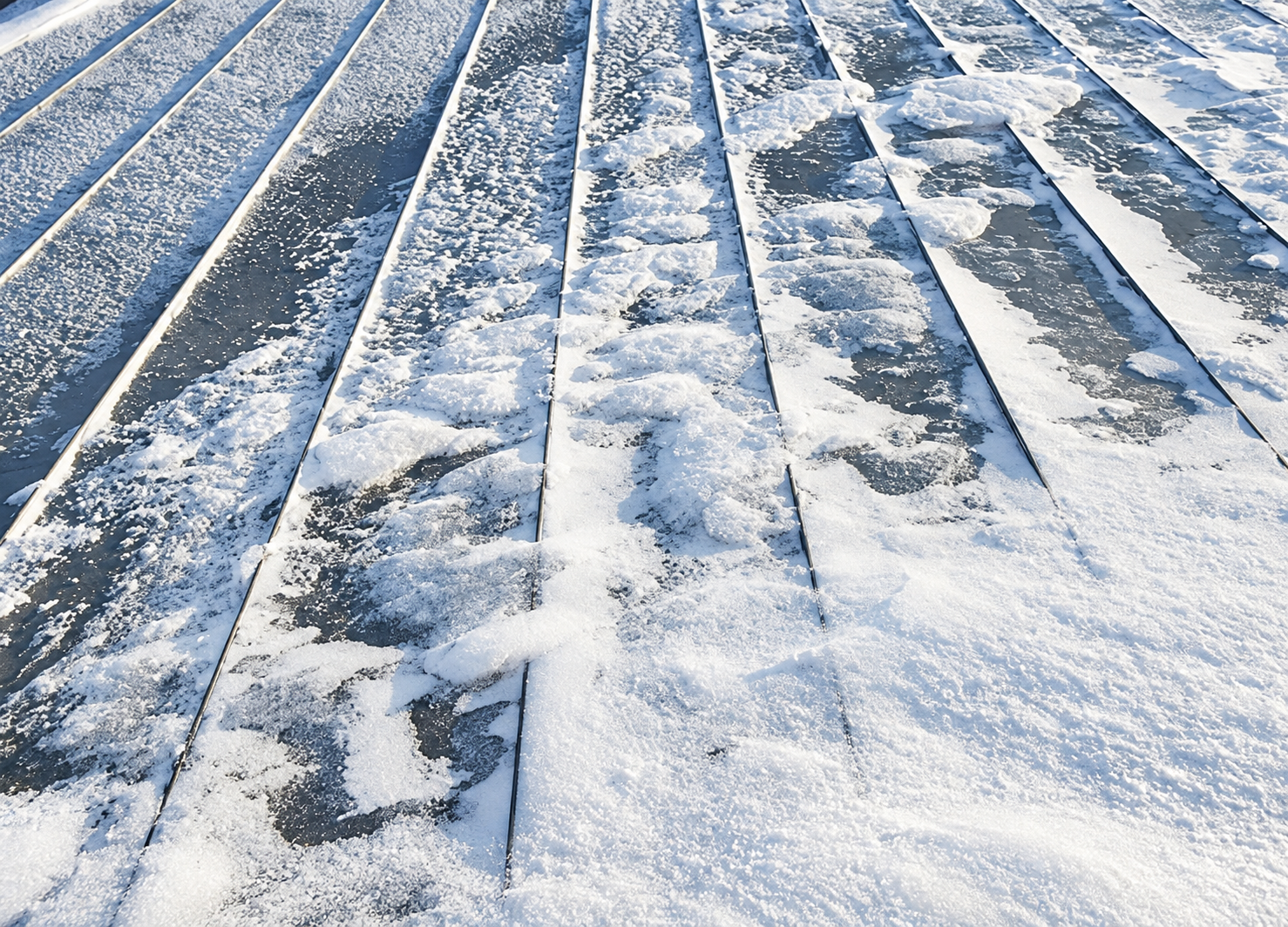
Wind moving across a flat roof drops its snow wherever the flow is interrupted. On a commercial building, that means against parapets, behind screen walls, around rooftop mechanical units, and in the step where a lower roof section meets a taller wall. Those are exactly the places where the load concentrates well past what the standard 35 pounds per square foot ground snow load implies. Under ASCE 7 provisions, these drift surcharge loads must be calculated based on the windward or leeward "fetch" (the unobstructed length of roof upwind of the obstruction).
Two Practical Consequences
- Altered Roof Dynamics: A roof that has performed flawlessly for fifteen winters can suddenly fail after a new mechanical unit or screen wall is installed. The new obstruction creates a completely new, un-engineered snow drift pocket.
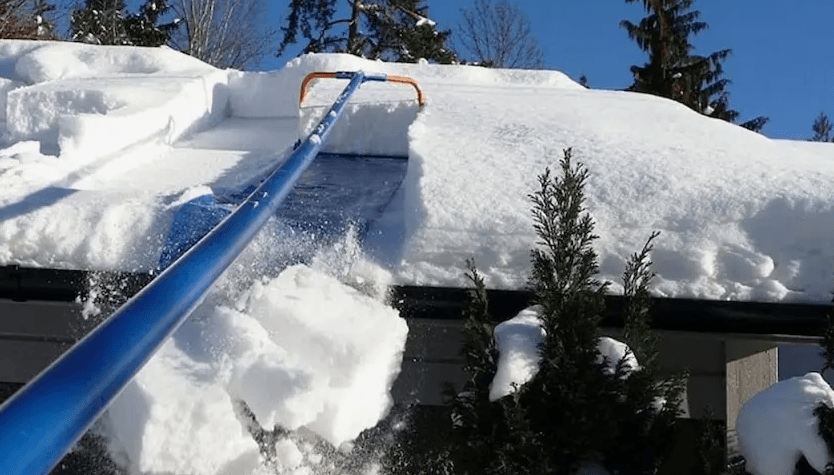
- Strategic Snow Removal: Piling cleared snow into concentrated heaps on a flat roof creates a dangerous point load. This dense, piled weight stresses the roof deck far worse than the uniform blanket you just removed.
Our systematic approach to clearing these specialized drift zones safely is outlined on our roof snow removal page.
Repair, Restore, or Replace
The most expensive mistake in commercial roofing is coating over a roof that is already wet inside. Here is how the decision actually gets made.
The question that comes first: is there moisture in the assembly?
A membrane can look serviceable while the insulation underneath is saturated from years of small leaks. A coating applied over that seals the water in, the insulation keeps losing R-value, the deck keeps corroding, and the owner has paid for a restoration that made the underlying problem invisible instead of fixing it. Moisture surveys exist for this reason, and on any building where the leak history suggests it, that survey comes before a coating recommendation rather than after.
Repair
Makes sense when the problems are localized: a handful of seams, a few flashing terminations, damage around a specific penetration, or storm damage confined to one area. Most of what we do on commercial roofs is this, and an owner is usually better served by targeted repair plus a maintenance program than by a capital project they did not need.
Restore
Makes sense when the membrane is aging but the assembly is dry, the substrate is sound, and the roof's remaining life can be meaningfully extended for substantially less than replacement. It is a real option and it is also the one most oversold in the industry.
Replace
Makes sense when the insulation is wet, the deck is compromised, the roof has reached the end of its service life, or the assembly's fundamental problems are drainage and geometry that no surface treatment will fix. It is also the only point at which those problems can actually be corrected, which is worth factoring in.
We will tell you which one we think you are in, and we will put the reasoning in writing with photographs behind it.
Maintenance Programs
A commercial roof that gets looked at twice a year outlasts one that gets looked at when it leaks, and the gap is not small.
What a program covers: a pre-winter and a post-storm inspection each year, drains and scuppers cleared before freeze-up, seams and terminations checked, flashing and penetrations inspected, perimeter and corner zones assessed first, minor repairs handled during the visit, and a written photographed condition report each time.
The two reasons it pays that owners underweight. Manufacturer warranties on commercial systems frequently require documented maintenance, and a warranty claim on an undocumented roof is a difficult conversation. And after a storm, an insurer deciding whether damage is sudden or gradual is looking for exactly the kind of dated record a maintenance file provides.
Pricing depends on square footage, roof complexity, and the number of penetrations. Quoted per property
Commercial Storm Damage and Claims
Wind and hail damage on a commercial building works differently from a house, and three differences matter.
The documentation burden is higher. A commercial claim typically involves a property manager, an owner, sometimes a lender, and an adjuster who may be handling a large loss across a region. Photographs organized by roof section, with dates and a written scope, are the difference between a claim that moves and one that stalls.
Deductibles are structured differently. Commercial policies commonly carry larger deductibles than residential, and some carry separate wind and hail deductibles calculated as a percentage of the insured value. That percentage on a large building is a substantial number, and it changes whether filing makes sense at all.
Operations do not stop for the roof. Tenants, inventory, and staff are underneath. Emergency stabilization on a commercial building is about protecting what is inside as much as the structure, and phasing the permanent work around the business is part of the job rather than an accommodation.
The general mechanics of how a roof claim unfolds are on our [storm damage page
What Commercial Roofing Costs in Tooele County
Commercial ranges run wider than residential because square footage and scope vary so much more. Typical Tooele County figures:
Typical Tooele County market ranges; estimates only. Bars show per-square-foot systems on a shared scale — restoration in rust, replacement in navy. Rows with a pill are priced on the basis named, because deck type, insulation condition, penetrations, height and access all move them independently.
Commercial pricing does not reduce to a per-square-foot number, because deck type, insulation condition, number of penetrations, roof height and access, and how much of the perimeter needs re-detailing all move it substantially. Every proposal itemizes the assembly, the attachment method, the perimeter and corner zone treatment, and any drainage correction, so you can compare bids on the same lines instead of on a single total.
"A single number is easy to give and impossible to check. Ask what basis it was priced on."
Our Commercial Roofing Process
01
Free Assessment
Full roof walk with photographs organized by section: membrane and seam condition, drains and drainage patterns, flashing and terminations, penetrations, and the perimeter and corner zones first. Interior inspection where there is leak history, because what the deck looks like from underneath is information you cannot get from the roof.
02
A Written Condition Report
Plain language, photographed, with findings marked as immediate, this season, or monitor. Yours to keep whether you hire us or take it to your board.
03
The Number, in Writing
An itemized proposal specifying assembly, attachment, edge and perimeter treatment, and any drainage correction. Where more than one path is reasonable, we price more than one and explain the trade-off rather than presenting the largest option as the only one.
04
The Work, Phased Around You
Scheduling built around your operating hours, tenants, and access requirements, with staged tear-off and same-day dry-in so no section is left open overnight.
05
Closeout
Completion photographs by section, warranty documentation registered, and the condition report filed so your next inspection starts from a baseline rather than from scratch.
Why Choose Us for Commercial Work
We quote the perimeter as the design, not a detail
Corner and edge zone fastening and edge metal selection appear on our proposals as specified line items, because in this valley that is what the roof is actually buying.
We check for trapped moisture before recommending a coating
Sealing water into an assembly is the most expensive mistake available in low-slope roofing, and it is also the easiest sale.
Repair is a real recommendation for us
Most commercial roofs we look at need targeted work and a maintenance schedule, not a capital project, and that is what the report will say when it is true.
Documentation built for the people who need it
Boards, lenders, insurers, and adjusters all want the same thing: dated photographs by section and a written scope. That is our default output.
Commercial Roofing FAQs
Start With the Report
Free assessment, photographs organized by roof section, and a written condition report you keep, whether the answer is a repair, a maintenance program, or a capital project.
Or Call: 385-527-3313