Roofing in Grantsville, Utah
Grantsville has a housing profile you rarely see this cleanly split. Roughly 7 percent of its homes were built before 1940, and nearly half were built after 2000. There is a genuine nineteenth century town here, incorporated in 1867, laid out on a wide pioneer grid with SR-138 running straight through as Main Street. And there is a fast-growing modern city wrapped around it, one that went from about 6,000 residents in 2000 to over 12,600 by 2020 and has kept climbing since.
Those two Grantsvilles need completely different roofing conversations, and out at the edges there is a third: the acreage, the horse properties, and the shops and barns that most roofing companies will not bother to quote. Tooele Roofing Co works all three, and on a property with several structures we walk every one of them in a single visit.
Get Free Grantsville Roof Inspection
The Old Grid and the New Subdivisions
The historic core. Grantsville was settled in 1850 and incorporated in 1867, and the pioneer town is still legible in the street grid and the buildings on it. The adobe schoolhouse on East Main dates to 1861 and is one of the better preserved in the state. Homes from that era and the decades after carry generations of re-roofing decisions, board decking rather than plywood, chimneys built long before step flashing was standard, and deep lots with mature trees that shade north eaves through the winter and fill gutters every fall.
Work on these houses is slow and careful by necessity. We inspect and photograph before quoting, price decking per sheet up front, and expect to find layers. A house that has stood for well over a century has earned the right to hold a surprise, and it should show up in the estimate rather than in a phone call on day two.
The post-2000 subdivisions. Nearly half of Grantsville's housing went up after 2000, which puts a large share of those roofs somewhere between fifteen and twenty five years old right now. That is exactly the window where builder-grade asphalt starts giving up, and in this valley it usually gives up at the seal strip rather than the shingle body. What we find on these streets, repeatedly, is a roof that looks perfectly respectable from the sidewalk with tabs that lift by hand across whole slopes.
The parts that fail even earlier are the ones nobody thinks about: pipe boots, which are rated for around a decade and frequently do not make it that far here, and flashing details that were installed to minimum spec during a construction rush. A modest repair at the right moment is often the difference between a good roof at year twenty and a replacement at year seventeen.
The West Side of the Valley Has Its Own Weather
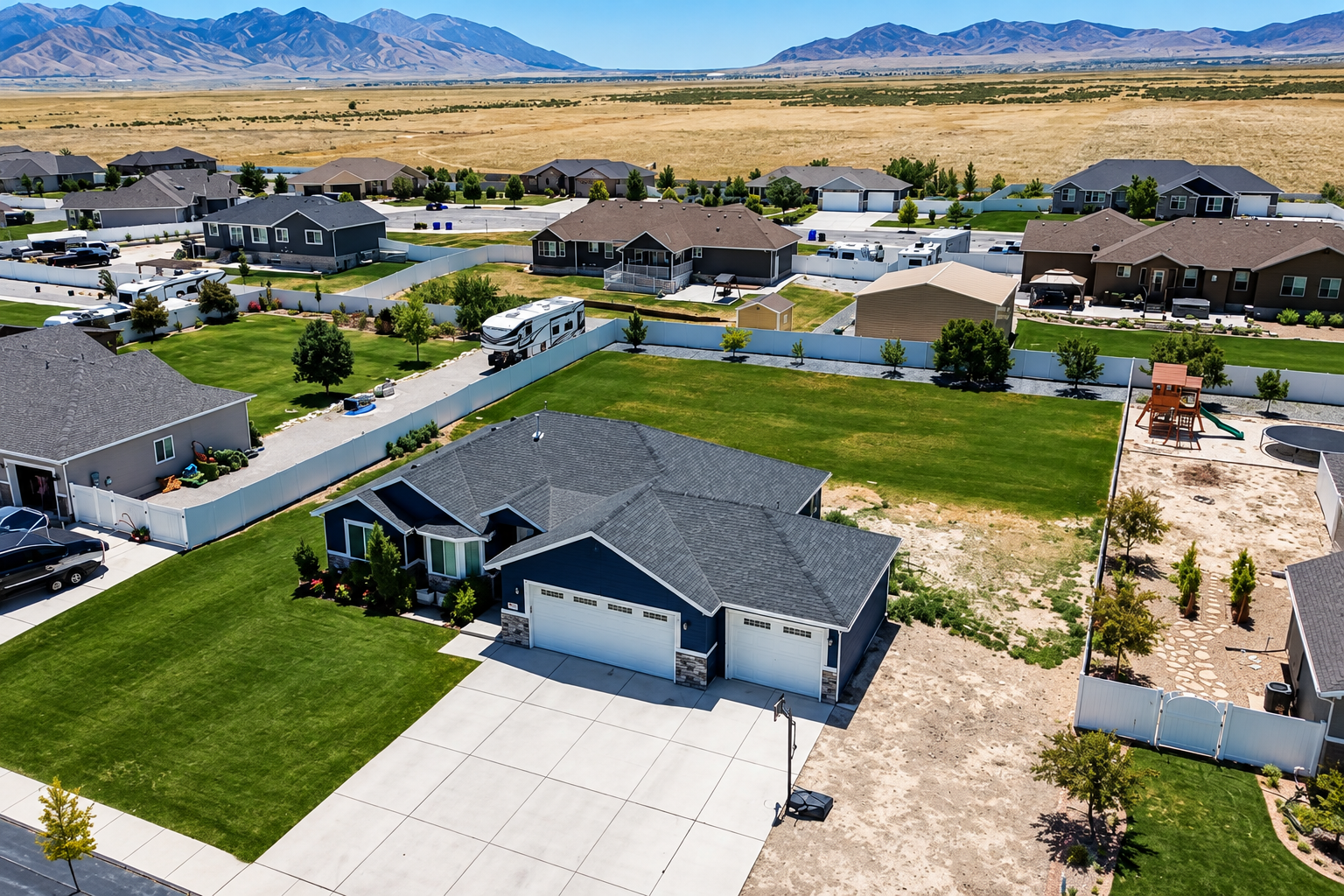
Grantsville sits at the base of the Stansbury Range, with South Mountain closing the valley off to the south and the ground opening north toward the Great Salt Lake and Stansbury Island. There is very little between the town and the open valley floor, and even less out on the acreage.
The August 2026 storms named Grantsville specifically. The National Weather Service confirmed an EF-1 tornado in the county along with a supercell producing gusts above 90 miles per hour, and warnings that month cited measured gusts of 70 miles per hour and hail at two inches across Grantsville and the surrounding communities.
What that means for a roof here is that the edges do the work. Rake edges at gable ends, eaves, and ridge caps are where wind gets a purchase, and once it has one, the rest of the roof is leverage. On every Grantsville job we treat the perimeter as the point: six-nail fastening, sealed starter strip at rakes as well as eaves, and ridge caps fastened for uplift.
The Shops, Barns and Outbuildings
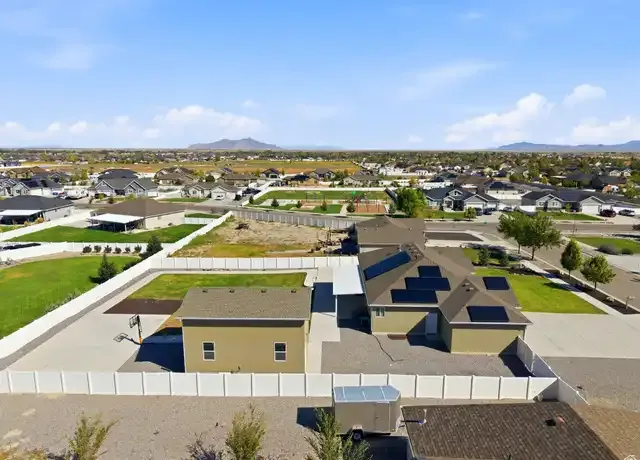
Grantsville is still a working town. There are horses, pastures, hay, equipment, and the buildings that go with all of it, and out toward Sheep Lane and the county fairgrounds the acreage properties often carry three or four structures apiece.
These buildings get skipped. They are too small to interest a commercial roofer and too odd to fit a residential route, so their owners either get no quote or get one that reflects how little the contractor wanted the job. We quote them properly, and we quote all of them in one visit with an itemized number per structure and a prioritized order, so you can plan across two or three seasons rather than reacting to whichever roof leaks first.
The single most useful thing to know about an exposed-fastener metal building is that it leaks at the screws long before the panels fail. The sealing washers dry out and shrink while thermal cycling backs the screws out of the purlins, and the result is scattered drips with no pattern and rust streaks under the screw heads. People assume the roof is finished and go price a replacement. Usually the panels are fine and a fastener and washer service costs a fraction of a re-roof. Details on our shop and outbuilding page.
What Grantsville Roofs Are Up Against
Open exposure on the west side of the valley, with limited windbreak and none at all on the acreage.
Seal strip fatigue across the post-2000 subdivisions, where a large group of roofs is aging on the same schedule.
Builder-grade boots and flashing failing years ahead of the shingles around them.
A century and a half of roofing history on the pioneer grid, including layers, board decking, and pre-standard chimney flashing.
Hail, documented at two inches in the county in August 2026.
Outbuildings that nobody inspects until something is visibly wrong inside.
Roofing Services in North Logan
List of Services
-
Roof Replacement
Full tear-offs with high-wind fastening and per-sheet decking pricing, on historic homes and newer subdivisions alike.
-
Shop, Barn & Outbuilding RoofingList Item 1
Fastener and washer service, panel repair, and full re-roofs, with every structure on the property quoted in one visit.
-
Storm & Wind DamageList Item 3
Documented inspections after wind and hail events, including every building on the property, not just the house.
-
Roof RepairList Item 2
Ridge caps, rake edges, creased shingles, flashing, and the pipe boots that fail first in the newer neighborhoods.
-
Metal RoofingList Item 4
Standing seam and panel systems detailed for uplift at the edges, which is where metal roofs actually fail out here.
Grantsville Roofing Questions
South, past the Stockton Bar and into Rush Valley: Stockton, where the elevation climbs and the winters are longer.
One Visit, Every Roof on the Place
Pioneer-era house, new subdivision, or a property with four buildings on it. Free inspection, photographs you keep, and an itemized number for each structure.
Or Call: 385-527-3313