Ice Dam Removal & Prevention in Tooele, Utah
Most people are surprised to learn Tooele gets more snow than Logan does. Historical climate records put the valley's annual average at roughly 65 inches, with some sources placing it higher, against Logan's 50 or so. What Tooele does not have is Cache Valley's sustained deep freeze, and that turns out to matter more than the totals. Here the sun comes out between storms, the daytime temperature climbs, snow melts on the roof, and then the night drops it all back below freezing. That cycle repeats through the winter, and every repetition is another chance for water to work its way somewhere it does not belong.
Tooele Roofing Co handles both ends of this. Removal, using low-pressure steam that lifts the ice off without taking shingles with it. And prevention, which is the part most companies skip, because a dam that gets steamed off in January and returns in February was never really a roof problem in the first place. We will show you where yours is actually coming from.
Schedule My Free Prevention Inspection
How Ice Dams Form on a Tooele Roof
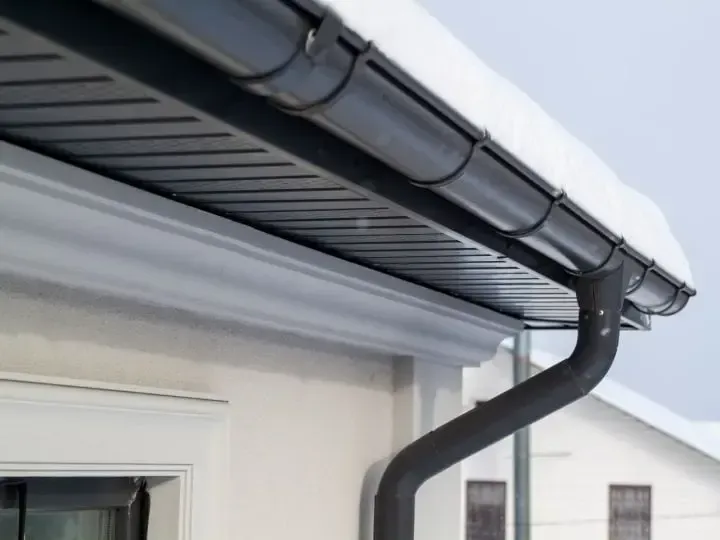
The basic mechanism is the same everywhere. Snow on the upper roof melts, the water runs down the slope, it reaches the eave where there is no warm attic underneath, and it refreezes. That ridge of ice grows, meltwater ponds behind it, and the standing water works backward underneath shingles that were built to shed falling water and were never designed to hold back a pond.
What differs from valley to valley is what supplies the melt. Here there are two sources, and telling them apart is the entire diagnosis.
Source one: heat leaving your house. Warm air escapes into the attic through recessed lights, bath fan housings, the attic hatch, duct chases, and gaps at the top plates. It warms the underside of the roof deck and melts the snowpack from below, even when the outside air never gets above freezing. This is the classic cause and it is the one you can fix permanently.
Source two: the sun. This one gets left out of nearly every article on ice dams, and in this valley it should not be. Tooele sits outside the persistent winter fog that settles over some Utah valleys, and it gets real sun between storms. Direct sun on a dark south or west facing slope will melt snow at the surface while the air temperature stays well below freezing. That meltwater runs down to an eave that is still in shadow, still frozen, and often still in the wind, and it locks up there.
Why that distinction matters to you. A solar-fed dam can form on a house with a perfectly sealed, properly insulated attic. If a contractor tells you every ice dam is an insulation failure and quotes you an attic package without going in the attic, be skeptical. Some Tooele dams are attic problems, some are geometry and exposure problems, and plenty are both. The free inspection is how you find out which one you are paying to fix.
The wind factor. Wind decides where the snow is before any of this starts. It scours one slope down to the shingles and stacks the difference on another, and it builds drifts behind ridges, dormers, and chimneys. Dams here tend to form in specific spots rather than evenly along the eave, and the spot is usually downwind of something. If your ice always shows up in the same twenty feet of roof, the wind pattern around your house is part of the explanation.
Water runs down the slope until it crosses the eave, where there's no warm attic underneath. It refreezes into a ridge of ice, meltwater ponds behind it, and the standing water works backward under shingles built to shed falling water, never to hold back a pond.
Warm air escapes into the attic through recessed lights, bath fans, the attic hatch, duct chases, and gaps at the top plates. It warms the underside of the deck and melts the snowpack from below, even when the outside air never gets above freezing. This is the cause you can fix permanently.
Direct sun on a dark south or west facing slope melts snow at the surface while the air stays well below freezing. That water runs down to an eave that's still in shadow, still frozen, and often still in the wind — and it locks up there. A solar-fed dam can form on a house with a perfectly sealed attic.
Before any of this starts, wind scours one slope down to the shingles and stacks the difference on another, drifting behind ridges, dormers, and chimneys. Dams here form in specific spots rather than evenly along the eave — and the spot is usually downwind of something. If your ice shows up in the same twenty feet every year, that's the explanation.
Simplified cross-sections; every roofline loads snow, loses heat, and catches sun differently. Some Tooele dams are attic problems, some are geometry and exposure problems, and plenty are both — the free inspection is how you find out which one you're paying to fix.
Getting the Ice Off Without Wrecking the Roof
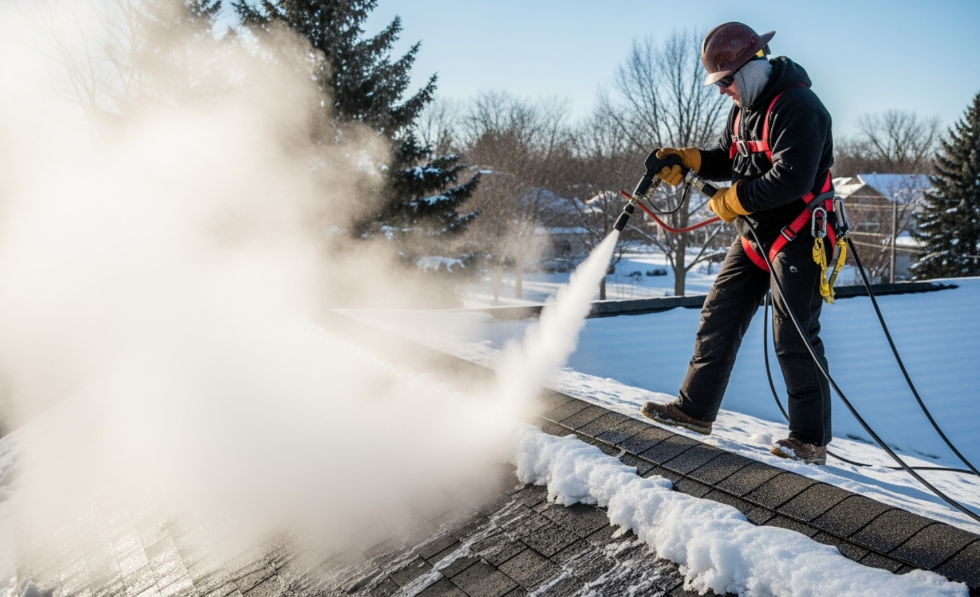
What we use: low-pressure steam. A steam unit melts channels through the dam and releases it in sections. Heat rather than force, which is the only approach that takes ice off a shingle roof without taking part of the roof along with it. Before and after photos come with every removal.
What we will not use, and what to ask about if someone else quotes you:
- Pressure washers: They strip ice and granules together. The removal is cheaper and it costs you years off the roof.
- Hammers, hatchets, chisels, ice picks: Ice bonds to shingles. Chip the ice and shingle comes off with it. We repair the results of this every spring.
- Rock salt and ice melt pucks: Sodium chloride corrodes gutters, fasteners, and flashing, kills whatever is planted under the drip line, and stains the roof. The calcium chloride in a sock trick you will find online is gentler and still buys days rather than fixing anything.
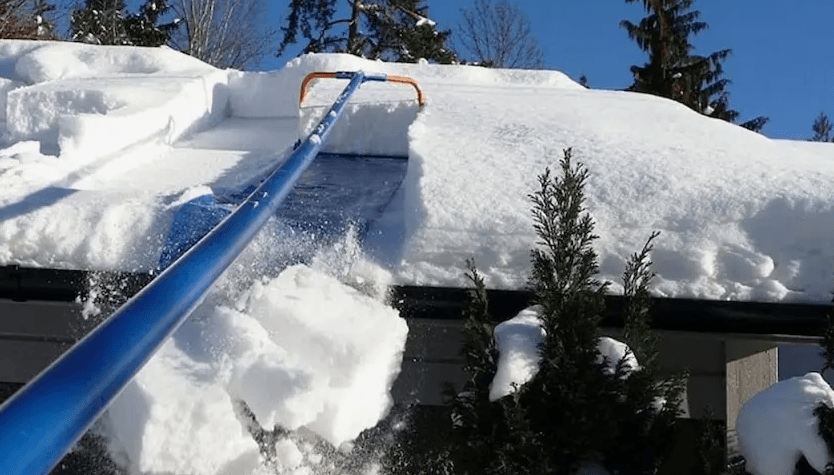
What you can safely do yourself: After a storm, pull the bottom three or four feet of snow off with a roof rake from the ground, leaving an inch or two so the rake never contacts shingle. Removing the snow supply above the eave genuinely helps and costs nothing. No ladders, no climbing, no chipping. In this valley, add one more rule: not in the wind. A roof rake is a long metal pole and a gust will use it against you.
Keeping Ice Dams From Coming Back
Three groups of work, in the order we recommend tackling them:
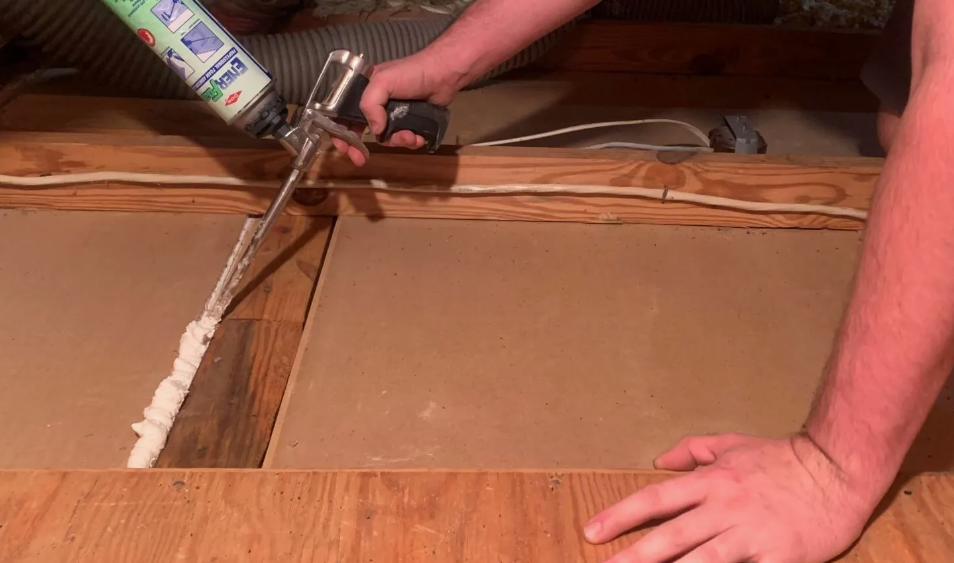
Group one: stop the heat from getting up there
This is the cheapest work with the largest effect, because insulation cannot compensate for an air leak. The standing list we work through: recessed can lights, bath fan housings, the attic hatch, plumbing vent penetrations, wiring holes, gaps along top plates, and the chase around the chimney or furnace flue. Small gaps get foam, large chases get rigid board and foil tape, and anything near a flue gets high temperature fire rated sealant at the clearance code requires, never expanding foam.
Then get the moisture and heat sources out entirely. Bath fans, range hoods, and dryers have to terminate outside through insulated duct with a working damper, not into open attic space and not into a soffit vent where it gets drawn straight back in. The one homeowners never suspect is HVAC ductwork running through the attic. Leaky supply ducts pour heated air directly against the roof deck, and sealing and insulating them is frequently the single biggest heat loss fix in the house.
A thermal camera on a cold morning finds all of this in about fifteen minutes, which is how we prioritize the list instead of guessing at it.

Group two: keep the attic cold and let it breathe
Insulation goes over the sealed attic floor, blown in to current depth with markers left in place so the job is verifiable. Baffles hold the airway open at every rafter bay, and the attic hatch gets its own insulated, weatherstripped cover.
Ventilation has to be balanced between intake at the soffits and exhaust at the ridge, and the balance is the part that gets botched. A ridge vent with no working soffit intake pulls its makeup air out of your house. Two specific mistakes: do not pair a ridge vent with open gable vents, which short circuits the airflow so it never reaches the eaves, and do not run a powered attic fan in winter, which depressurizes the attic and pulls heated air up out of your living space.
One detail that matters more here than in most places: use an externally baffled ridge vent. Unbaffled ridge products let wind driven snow blow straight into the attic during a storm, where it melts on the deck and looks exactly like a roof leak in March. In a valley that produces both heavy snow and hard wind, this is not a theoretical concern.
Group three: deal with what the roof shape and the sun are doing
Some dams are architectural and no amount of insulation reaches them:
Chimneys without a cricket dam snow on their uphill side every single winter. That gets built, not insulated around.
Dead valleys behind dormers hold shaded ice for months while the rest of the roof clears.
Clogged gutters give meltwater nowhere to go the moment it finally does thaw.
Ice and water shield goes down at eaves, valleys, sidewalls, and skylights whenever the roof is replaced. On low pitch roofs and homes with deep eaves we run extra courses past the minimum, because on those geometries the code line lands short of where the dam actually sits.
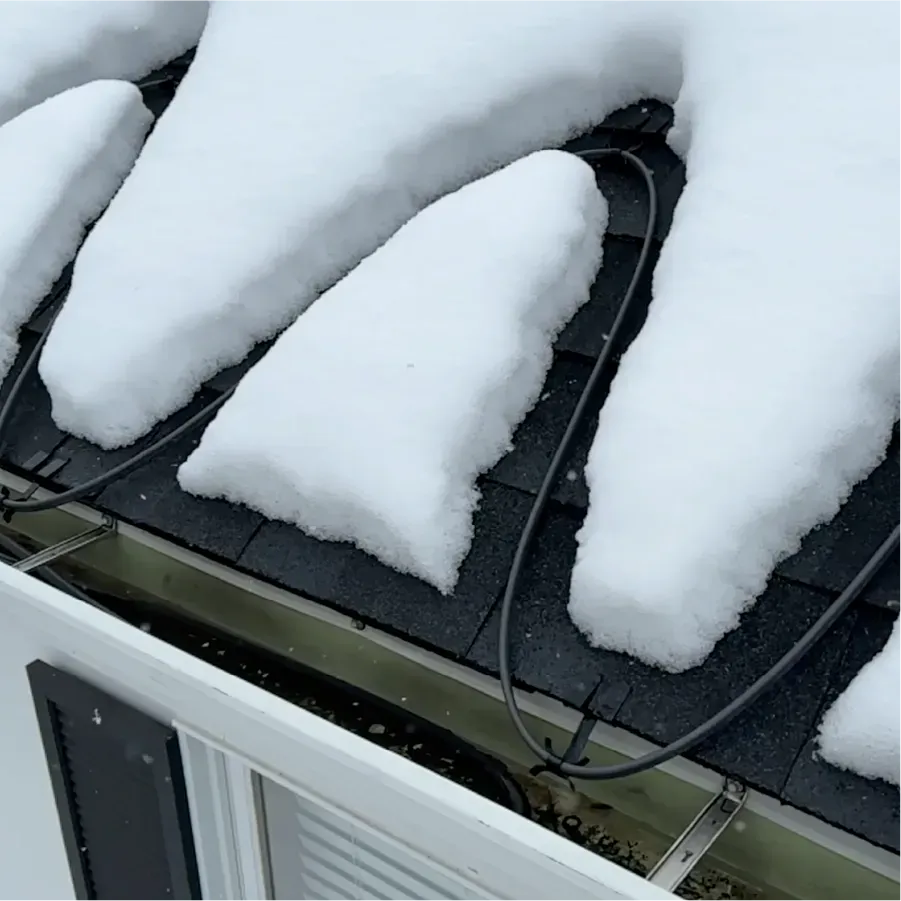
Heat cable for the places nothing else reaches: shaded dead valleys, north eaves under mature trees, and cathedral ceilings that have no attic to fix. Routing and layout in the heat cable section below.
Assistance worth checking before you pay full price
Attic insulation and air sealing are among the most commonly incentivized home improvements in Utah, and most homeowners we meet don't know it. Worth checking before you pay full price:
- Utah Community Action administers the federal Weatherization Assistance Program for Tooele County along with several neighboring counties. For income qualified households it can cover attic insulation and air sealing outright. Applications are taken locally rather than only in Salt Lake, including at the Head Start locations in Tooele and Grantsville.
- Rocky Mountain Power's wattsmart program offers efficiency incentives for insulation and related work. Unlike Logan, which runs its own municipal utility, Tooele Valley is Rocky Mountain Power territory.
We are roofers, not rebate specialists, and we do not process applications for you. What we will do is document the work with the invoices and R value details these programs ask for, so applying is not a research project.
Heat Cable, and Where It Actually Belongs
Heat cable gets sold as an ice dam solution. It is not one. It is a drainage tool, and understanding the difference is what separates a cable that earns its keep from a cable that adds to your power bill every winter without changing anything.
What it actually does. Heat cable does not stop ice from forming. It melts a continuous channel through the ice so meltwater has somewhere to go instead of pooling behind a dam and backing up under your shingles. The dam can still be there. The water just has an exit.
That makes it the right answer in exactly one situation: where prevention genuinely cannot reach. Which in this valley means:
- Shaded dead valleys behind dormers, where ice sits for months because the sun never touches it
- North-facing eaves under mature trees, same problem
- Cathedral ceilings and vaulted rooms with no attic at all, where there is no space to air seal, insulate, or ventilate. Nothing in the prevention section above applies to these, and cable is often the only tool left
- Eaves fed by solar melt rather than by attic heat, which is common here and is not fixable with insulation. If the sun is melting snow on a dark upper slope and it is refreezing at a cold eave, sealing your attic will not change that
Where it is a waste of money: run across a whole roof over a leaky, under-insulated attic. That is paying monthly to manage a symptom you could have fixed once. Our order of operations is attic first, cable where the roof leaves no other option.
Routing decides whether it works
This is the part that gets done badly, and it is more important than which product you buy.
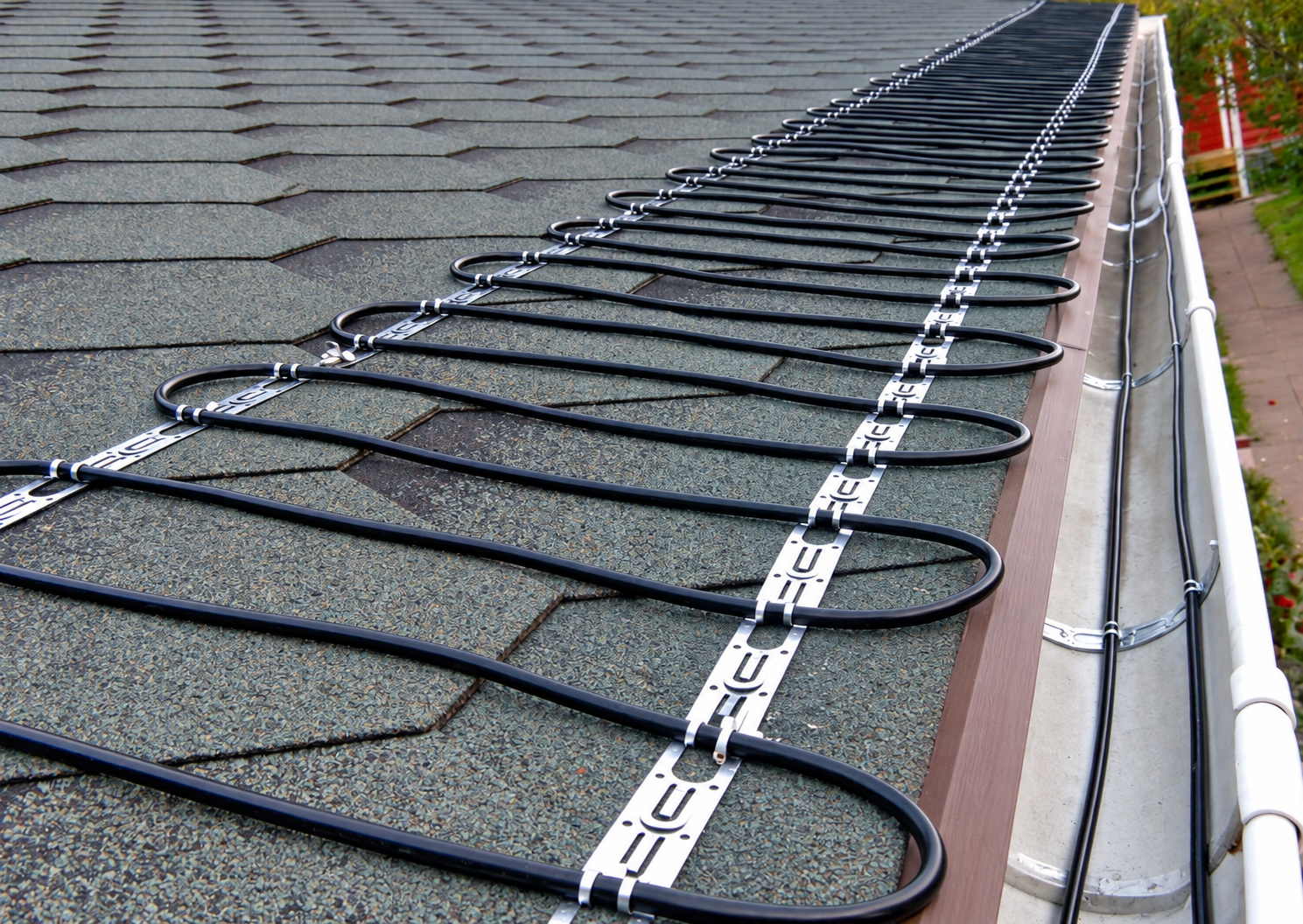
The cable has to reach the ground. A zigzag at the eave that melts a channel and dumps water into a frozen gutter has accomplished nothing. The run continues into the gutter and down through the downspout to the bottom, so the meltwater has a complete path off the roof. A heat cable that stops at the gutter line is the single most common installation error we find.
It follows your roof's actual geometry. Valleys get cable. Dead valleys behind dormers get cable. The eave gets a zigzag sized so the melted channel is wide enough to matter, not a token loop. We lay out the run on the roof before quoting it rather than estimating by the foot from the driveway.
It gets clipped, not stapled. Cable is attached with clips designed for the purpose. Anything driven through a shingle to hold a cable has created a fastener penetration in the exact zone where water backs up.
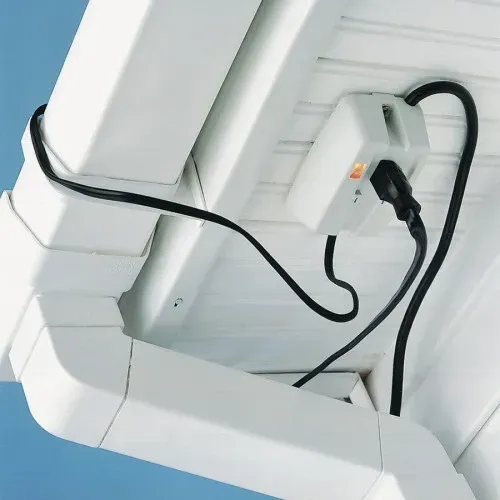
It needs a proper circuit. A dedicated exterior-rated GFCI circuit, sized for the run. Extension cords out a window are a fire and shock hazard and they are also how most cable failures start.
Self-regulating vs. constant wattage
Self-regulating cable changes output based on the temperature along its own length, drawing more where it is cold and less where it is not. It costs more up front, uses less power, and is considerably safer because it cannot overheat if it overlaps itself. This is what we install.
Constant wattage cable puts out the same heat everywhere regardless of conditions. Cheaper to buy, more expensive to run, and it will overheat at any point where it crosses itself. If a bid is unusually low, this is often why.
On controls: a manual switch means somebody has to remember, and the cable either runs all winter or runs the day after it was needed. A thermostat or moisture-sensing controller runs it only in the conditions that actually build dams, which is where most of the operating cost savings come from over a season.
Operating cost
Heat cable is not free to run, and anyone who tells you otherwise has not looked at a power bill. Actual cost depends on the length of the run, the wattage per foot, how cold your winter is, and above all whether it runs on a controller or runs continuously. Self-regulating cable on a proper controller can cut a season's operating cost substantially compared to constant wattage on a manual switch. We will give you a realistic estimate for your run before you commit rather than after.
What Heat Cable Costs
Typical Tooele County market ranges; estimates only. Hatched rows are quoted separately. Your exact number comes from a free inspection.
One honest comparison. If your ice dams come from attic heat loss, the same money spent on air sealing and insulation fixes the cause permanently and lowers your heating bill every winter afterward. If they come from roof geometry or solar melt on a shaded eave, no amount of attic work will touch it, and cable is the right buy. The free inspection is how you find out which one you have, and we will tell you honestly when the cheaper answer is the better one.
What Ice Dam Removal Costs in Tooele
Typical Tooele County market ranges; estimates only. Navy bars are emergency removal; the rust bar is the permanent fix. Two or three removal visits plus one ceiling repair costs roughly what the attic work costs.
Worth running the numbers on: two or three removal visits plus one ceiling repair costs roughly what the permanent attic work costs, and the attic work also lowers your heating bill every cold month afterward. We will put both figures in front of you rather than just quoting the emergency.
Removal is a service. Prevention is a decision. The inspection tells you whether prevention will even work on your roof.
Our Process
01
Triage Call
If water is coming in, we talk you through interior protection on the phone and prioritize the dispatch. If it is ice and no water yet, we schedule you promptly and say so honestly rather than selling you an emergency you do not have.
02
Steam Removal
Channels cut first to release the ponded water behind the dam, then sectional removal, photographed start to finish. We thaw the gutters and downspouts the dam froze shut while we are up there, because a cleared roof draining into a solid ice tube has not solved much.
03
Find the Feed
Every removal includes an attic side look and an assessment of the roof's exposure: where heat is escaping, what the insulation actually measures, whether a bath fan is venting into open attic, and whether sun and wind patterns are contributing. The dam is the symptom. This step is the diagnosis, and it is included.
04
The Permanent Plan
A written prevention plan with line item pricing, ordered by what returns the most for the least, from a weatherstripped hatch cover to full attic work. You fix what you want on your own schedule. The report is yours regardless.
Why Choose Tooele Roofing Co for Ice Dams
Steam only, with photos to prove it
Before and after images with every removal showing the shingles intact underneath. Ask a chipping or pressure washing crew for the same thing and see how the conversation goes.
We diagnose before we sell
Not every dam in this valley is an insulation failure, and we are not going to quote you an attic package without going into the attic first.
We would rather stop the calls than bill them
A removal company does well when your dams come back every winter. We would rather fix the cause and earn the replacement when your roof is eventually ready.
We are on this side of the Oquirrhs
During a valley wide freeze, everybody's crew is busy. Ours is at least starting from here.
Ice Dam FAQs
Find Out Where Your Ice Is Actually Coming From
Attic heat, winter sun, roof shape, or some combination. One free inspection tells you which, what it costs to fix, and whether it is worth fixing at all.
Or Call: 385-527-3313